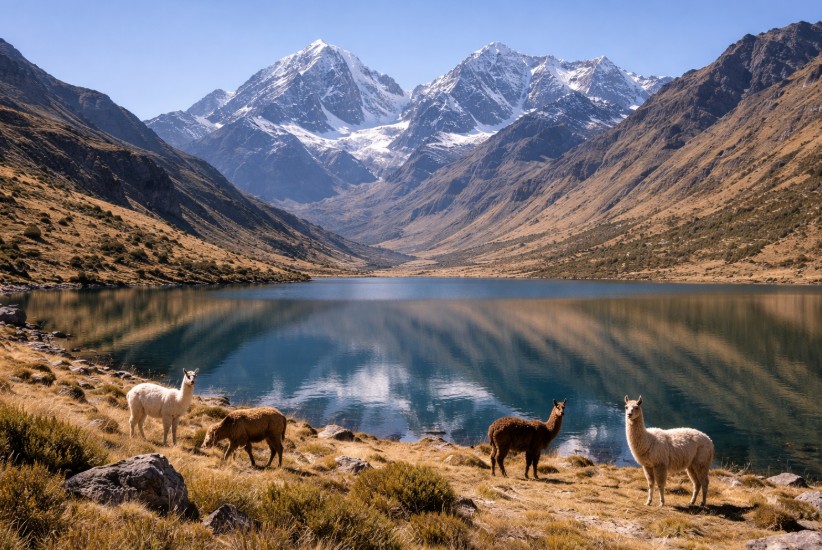
Most travelers who visit the Andes come for Machu Picchu. They leave having understood something larger — that the Peruvian Andes are not a backdrop for a single famous site but a living, layered world with its own food culture, its own relationship with the land, and an agricultural and spiritual tradition that predates the Inca by centuries.
This guide covers the three highland regions, the food, the altitude and the practical information you need to plan a highland Peru trip well.
1. The three Andean regions – and why they feel different
Peru’s Andes stretch the full length of the country and divide into three distinct regions, each with a different character, climate, and set of reasons to visit.
The Northern Andes: centered around Cajamarca and Chachapoyas — are lower, greener, and far less visited than the south. Cajamarca is historically significant as the place where the Spanish captured the Inca emperor Atahualpa in 1532, effectively ending the Inca Empire. Further north, the pre-Inca Chachapoya civilisation built the fortress of Kuélap, a walled citadel above the cloud forest that receives a fraction of Machu Picchu’s visitors and offers a completely different quality of experience.

The central Andes: Ayacucho, Huancayo, the Junín region — are the most overlooked part of highland Peru by international travelers. Ayacucho has more than thirty colonial churches and one of the most celebrated Holy Week (Semana Santa) processions in Latin America, drawing visitors from across the country each year. The pre-Inca ceremonial site of Chavín de Huántar, built approximately 3,000 years ago in what is now the Ancash region, is one of the most architecturally significant ancient structures in South America and sees very few foreign visitors.

The southern Andes: Cusco, the Sacred Valley, Lake Titicaca — are what most travelers imagine when they think of highland Peru. The concentration of Inca architecture, the quality of the food scene, and the dramatic landscape make this the natural center of any highland itinerary. It is also genuinely one of the most remarkable places in South America, and the familiarity of its name has not diminished what it actually is.

2. Altitude – the honest guide
Cusco sits at 3,400 metres (11,150 feet). The Sacred Valley ranges between roughly 2,800 and 3,600 metres. Machu Picchu, lower at approximately 2,430 metres, is often more comfortable than people expect after the harder acclimatisation in Cusco.
The most common mistake is arriving in Cusco and immediately trying to do everything. Altitude affects people differently, but the consistent practical advice is: arrive with a clear first day, eat lightly, avoid alcohol for the first 24 hours, and drink coca tea.
Coca tea — mate de coca — is available everywhere in highland Peru and is a genuinely effective mild remedy for the headache and breathlessness of the first day at altitude. It is not a cure for serious altitude sickness, but for the normal adjustment period it helps. It is also, simply, a good drink.
The concept of arriving slowly is not just practical — it reflects the Andean idea that the land asks you to respect its pace before it shows you what it holds.

3. What to Eat in the Peruvian Andes
Food is an important part of the Andean experience, shaped by altitude, local agriculture, and long farming traditions.
Chuño is one of the most remarkable food technologies in human history. At altitudes above 3,500 metres, Andean communities discovered that potatoes left outside overnight would freeze solid, and that by walking on them the following morning to expel the moisture, then repeating the freeze-dry cycle over several days, they could be preserved for years without refrigeration. Chuño — freeze-dried potato — was a foundation of the Inca food system and allowed a civilisation to function across thousands of kilometres of difficult, high-altitude terrain. It is still eaten in highland markets and traditional restaurants today. The flavour is dense and earthy, unlike fresh potato. Order it once — it connects you directly to the agricultural intelligence of the people who built what you have come to see.
Chicha de jora is fermented corn beer made from malted — germinated — corn. It was a ceremonial drink in the Inca world, used in religious and social rituals, and it remains an everyday drink in highland communities. In Cusco, look for houses or small premises with a red plastic bag or a bunch of flowers hanging over the door — these informal chicha bars, called chicherías, serve home-made chicha to locals and are among the most authentic food experiences in the highlands. They are rarely mentioned in guidebooks.
Cuy (guinea pig) — has been a protein source in the Andes for thousands of years and remains a significant part of highland food culture. It is typically roasted whole and served with potatoes and ají sauce. For travelers curious about eating historically and culturally rather than just safely, it is worth trying. The flavour is rich, closer to rabbit than chicken.
Rocoto relleno is the signature dish of Arequipa — a large red rocoto pepper stuffed with spiced meat, egg, and cheese, then baked. The rocoto is significantly hotter than most European palates expect, but the combination of heat, richness, and the slightly sweet pepper is genuinely excellent. Arequipa’s food scene is one of the most underrated in Peru and worth building time into your itinerary.
The story behind the food goes back further than you think. → Discover the history of Peruvian cuisine

4. Pachamama, the Andean relationship between food and earth
One of the most distinctive aspects of Andean food culture is that cooking and spiritual life are not separate activities.
Pachamama — the Earth Mother — is addressed in everyday life across the highlands, not only in formal ceremonies. The practice of spilling a few drops of chicha on the ground before drinking — an offering to the earth — is common in highland communities today. The Pachamanca, a cooking method in which meat, potatoes, and corn are buried in a pit lined with heated stones and cooked slowly underground, is both an ancient technique and a ceremonial act. The word itself means “earth pot” in Quechua. It is prepared for celebrations and family gatherings rather than in restaurants. If you are invited to participate in one, accept without hesitation.
This context matters for how you travel in the Andes. The terraced fields, the market offerings of coca and flowers, the ceremonies you may observe in highland towns — these are not performances for tourists. They are expressions of a worldview that connects food, land, and community in ways that tourist rarely encounters directly.

5. How to plan your highland visit
Getting there: Cusco has its own international airport with direct flights from Lima (approximately one hour and fifteen minutes) and from several other South American cities. Most highland itineraries are based in Cusco with day trips or multi-day extensions into the Sacred Valley.
How much time to allow: Four to five days in Cusco and the Sacred Valley is a realistic minimum for seeing the main sites without rushing and giving your body adequate time to adjust to the altitude. Add two days for Machu Picchu (one day is possible but tight). The northern and central Andean regions require separate planning and are best treated as extensions to a longer Peru trip.
How the Andes fits in a wider Peru itinerary: Most travelers arrive in Cusco after Lima. Flying directly to Cusco from Lima and spending your first day resting rather than sightseeing is the single most effective way to make your highland time more enjoyable.
Keep Exploring
The Andes are the part of Peru where the past and the present are most clearly the same thing — in the food, in the ceremonies, in the terraces still being farmed above the valley floor.
If the highlands have opened your curiosity about the third of Peru’s worlds, the Coast and Amazon are next.

Leave a Reply