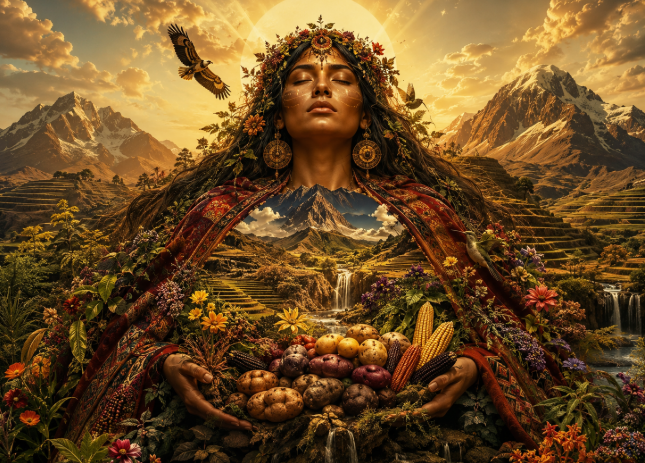
In Quechua, the language of the Inca, Pachama means earth — but also time, and space, and the cosmos. Mama means mother. She is the mother who is the earth, the time, and the world — all at once. I grew up in Peru. In the Andes, Pachamama meaning is not a metaphor or a brand. She is a deity — a real being in the Andean cosmological framework — with specific attributes, specific relationships, and specific expectations of the people who live on her land. Understanding what that actually means is one of the things that changes how you experience Peru when you travel there.
So here is the real version. No mystification, no lecture — just what Pachamama is, what she means to Andean communities, and what it looks like in practice.
What Pachamama actually is
In Quechua — the language of the Inca, still spoken by millions across Peru, Bolivia, and Ecuador — the word breaks down as Pacha (earth, time, space, world) and Mama (mother). Pachamama encompasses not just the physical earth but time and the cosmos together. She is not a symbol. She is a living force that sustains everything that exists on and within the land.
Crucially, Pachamama has two faces. She is nurturing and generous — the source of food, water, fertility, and protection. But she is also capable of withholding those things if the relationship is not maintained properly. Earthquakes, crop failures, landslides: in the traditional Andean view, these are not random events. They are signs of imbalance, of a relationship that has been neglected or broken.
This is why Andean culture places such emphasis on the principle of ayni — reciprocity. The relationship with Pachamama is not passive gratitude. It is an active, ongoing exchange. You give before you take. You offer before you ask. You acknowledge what you receive. This is not religious obligation in the Western sense. It is the operating logic of a culture that has farmed extreme altitude for ten thousand years without destroying it.

The three worlds: where Pachamama sits in Andean cosmology
To understand Pachamama fully, it helps to know the basic structure of the Andean cosmological view. Reality is understood as three interconnected planes:
Hanan Pacha — the world above: the sky, the stars, the divine realm. Associated with the condor.
Kay Pacha — the world of the present, the everyday world in which humans live. The world of the puma.
Ukhu Pacha — the world within: the underground, the ancestors, the seeds that have not yet germinated. The world of the serpent.
Pachamama is the ground on which all three interact. She is Kay Pacha — the present world — but she also holds the seeds of Ukhu Pacha and receives offerings that travel between all three planes. When a paqo (an Andean priest or spiritual specialist) performs a ceremony, they are working within this three-part framework, directing energy and offerings across all three worlds simultaneously.

August: the month that belongs to the earth
If you are in Peru or Bolivia in August, you will notice that something is different. August 1 is Día de la Pachamama — a day of particular spiritual intensity when the earth is considered ‘open’ or ‘awake’, more receptive than at any other point in the year. In agricultural communities, this is understood in practical terms: August marks the transition between harvest and the next planting cycle. The earth has given everything she had. Before asking again, you give back.
On August 1, families across the Andean highlands bury offerings in their fields, their homes, and at significant natural sites. The central ritual is the despacho — a carefully arranged bundle of offerings prepared by a paqo. The despacho is not a performance. It is a private, community-centred act directed at maintaining a relationship — not at impressing anyone.
Coca leaves and the challa: daily reciprocity
The grand ceremonies are one part of the relationship with Pachamama. The daily part is quieter and more constant.
Coca leaves are central to virtually every offering and ceremony in the Andes. The plant itself is sacred — not for the alkaloid content that makes it useful for altitude, but because it is considered a direct medium of communication between humans and the spiritual realm.
The challa is the everyday version of this: before drinking chicha (fermented maize) or any significant beverage, you pour a little onto the ground first. Not as a ritual, exactly — more as a reflex. A habit of acknowledgement. I have done this my whole life without thinking about it. Most Peruvians in the Andes do the same.

Syncretism: how Pachamama survived the colony
The Spanish arrived in the 16th century and spent considerable energy attempting to dismantle Andean religion. They did not entirely succeed, in part because the communities they were trying to convert were skilled at adaptation. Pachamama was identified with the Virgin Mary — a parallel that made enough surface sense (both are maternal, both are revered, both offer protection) that the association held. Festivals that had been Andean ceremonies were reframed as Catholic feast days. The sacred sites shifted names but not necessarily function.
The result is a living syncretism that you can still see today. The Virgen de la Candelaria festival in Puno, held in February, is simultaneously a Catholic celebration and one of the most elaborate expressions of Andean devotion in the Americas. The two layers coexist without contradiction for the people who hold them.

What this means for travelling in Peru
You do not need to attend a ceremony or understand Andean cosmology in depth to travel well in Peru. But knowing these things changes what you notice. You know it is not a tourist custom. It is a continuation of a practice of reciprocity that is genuinely old.
A few practical things worth knowing if you visit during a ceremony or sacred event:
Ask before photographing. Ceremonies are not performances. In many communities, cameras during active ritual are considered disruptive. If you want to document something, ask first and accept no gracefully.
Do not touch ceremonial objects unless invited. This is basic respect, but worth saying explicitly.
Distinguish authentic ceremonies from commercial ones. There are tour operators who offer ‘Pachamama ceremonies’ as entertainment. These are not the same thing. Authentic ceremonies are community events, not visitor experiences — though some communities do welcome respectful observers. Ask locally for guidance.
Pachamama is not in the past. She is in the earth under your feet when you walk the Andes, in the food that comes from altitude farming, in the coca tea offered to you for altitude sickness, in the fields that have been farmed by the same communities for thousands of years. Understanding her does not require you to believe what Andean communities believe. It only requires you to take it seriously.

Read next
Pachamama is inseparable from Andean food and agriculture. The sacred relationship with the earth is why the potato has more than 3,000 varieties in Peru and why chuño was invented.
Read: The Sacred Potato, and The Peruvian Andes: What to Expect for the landscape where all of this lives.
What part of this surprised you the most?
2 responses to “Pachamama Meaning: The Real Andean Cosmology Behind the Word”
-
J’ai bien aimé la partie où ça parle de la cosmologie andine.
-
C’est aussi une partie que je trouve très importante, car elle montre que la Pachamama n’est pas seulement une croyance, mais une manière de voir le monde.🌿
-


Leave a Reply