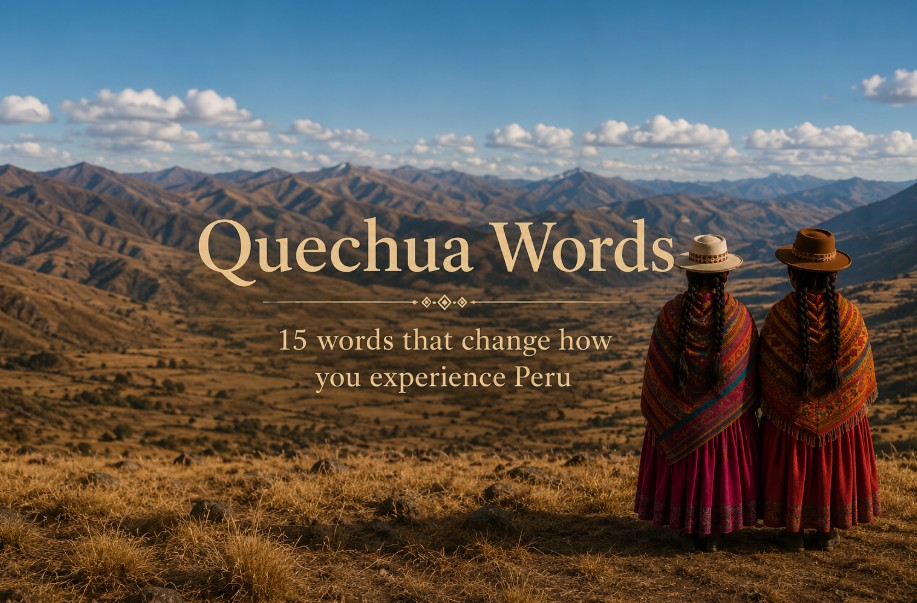
I grew up in Cusco, which means I grew up inside Quechua, even when I didn’t fully realize it. Quechua words are woven into the names of the streets, the mountains, the food, the ceremonies. You can’t live in Cusco and not absorb it, even if you’re not a fluent speaker.
Quechua consists of related languages with regional variants, particularly in Cusco and Áncash. In Peru, it has two main branches, Quechua I and Quechua II and at least seven variants used in education and public services, highlighting the diversity of its speakers.
Quechua originated before the Inca, expanding through trade along coastal routes long before the Spanish conquest. The Inca adopted it as their administrative language, and the Spanish later recognized its significance, utilizing it for evangelization across the continent.
Over 3.8 million people in Peru speak Quechua, an official language with legal rights for public services. Young Peruvians are using TikTok and YouTube to promote the language and challenge colonial stigma.
These fifteen words are not a language lesson. They are a cultural decoder. Each one carries a concept that changes what you notice when you travel in Peru.
The world as the Andes understands it
Pacha · PAH-chah (earth, time and space — all at once)
The root of Pachamama, and one of the most important words in the Andean worldview. Pacha does not mean just ‘earth’ — it means the totality of existence: the physical world, time, and space together. This is why the three realms of Andean cosmology are all called pachas: Hanan Pacha (the upper world), Kay Pacha (the present world), Ukhu Pacha (the inner world of ancestors and seeds). Understanding Pacha means understanding that for Andean culture, time and place are inseparable.
Ayni · AY-nee (reciprocity — giving before you take)
The operating principle behind Andean social and spiritual life. Ayni is mutual obligation: you help me today, I help you when you need it. It applies between people, between communities, and between humans and the land. When Pachamama receives offerings before a harvest, that is ayni. When highland families build each other’s houses collectively, that is ayni. It is the original economy of the Andes, and it is still functioning.
Apu · AH-poo (mountain spirit — guardian of a territory)
Every significant mountain in the Andes is an Apu: a living spiritual presence with a name, a character, and authority over the land around it. Ausangate, visible from Cusco on a clear day, is one of the most powerful. Salcantay guards the route to Machu Picchu. Andean guides still leave offerings at high passes when crossing into an Apu’s territory. When you look at the mountains in Peru, you are looking at something that has been in active relationship with the people at its base for thousands of years.
Inti · IN-tee (the sun — deity and political ancestor)
The Inca proudly proclaimed themselves as descendants of Inti, the Sun — not merely a myth but a vibrant political and spiritual truth. The Sapa Inca served as Inti’s magnificent representative on earth. Every June 24, the joyful Inti Raymi — the Festival of the Sun — brings lively celebrations to Cusco, with the awe-inspiring ceremony taking place at Sacsayhuamán. This event stands out as one of the most breathtaking cultural experiences in South America. If your travel plans align with this festive occasion, it’s absolutely worth making an effort to be a part of it!
Wiracocha · wee-rah-KOH-chah (the creator — before the Inca, before Inti)
Before the Inca honored Inti for political reasons, Wiracocha was the respected creator god of the Andean world — the powerful force that shaped the earth at Lake Titicaca and set everything in motion. The Inca temple of Raqchi, located south of Cusco, was dedicated to him. Knowing who Wiracocha is reveals an important layer beneath the Inca — the theological world they developed and adjusted.
Pachakutiy · pah-chah-KOO-tee (world-turning — the moment everything changes)
Pacha (world) + kutiy (to turn or return) together form Pachakutiy, which beautifully signifies a moment of radical transformation — a time when both time and space grace us with the opportunity to embrace a new era. The ninth Inca ruler proudly adopted the name ‘Pachacútec,’ believing he was part of such an inspiring change. In Andean thought, history unfolds not in a straight line but in a vibrant cycle, with Pachakutiy serving as the exciting hinge point between worlds. This concept continues to infuse optimism into discussions about Peru’s cultural and political future, encouraging a brighter path forward.

The three Pachas
Empire, community and people
Tawantinsuyu · tah-wan-tin-SOO-yoo (the four corners — the empire’s real name)
What we call the Inca Empire was known to the people who lived in it as Tawantinsuyu: the four regions united. Chinchaysuyu to the north, Antisuyu to the east (the Amazon), Kollasuyu to the south, Kuntisuyu to the west. At its height it stretched from what is now Colombia to central Chile — the largest empire in pre-Columbian America. Cusco was its centre — the Quechua name Qosqo means ‘navel of the world’.
Ayllu · AY-yoo (community as kinship — the social unit that built civilisations)
The ayllu is the foundational social structure of Andean life: an extended community held together by shared land, shared labour, and mutual obligation. The Inca managed an empire of millions through the ayllu system, organising collective labour without wages or money. Many highland communities in Peru are still organised this way. The ayllu is why Andean architecture, agriculture, and ceremony all carry the quality of collective work.
Chasqui · CHAS-kee (the relay runner — the human postal network)
The Inca had no horses and no writing system, but their communication network was extraordinary: relay runners stationed every few kilometres along 30,000 km of roads (the Qhapaq Ñan). A message could travel hundreds of kilometres in a day. Fresh fish from the coast arrived in Cusco still cold. The chasquis carried quipus and memorised verbal messages exactly. It is one of the engineering achievements of the empire that visitors to Peru rarely hear about.
Quipu · KEE-poo (knotted records — writing without an alphabet)
The Inca recorded everything — census data, tribute accounts, calendars, and possibly narrative histories — in quipus: fascinating systems of knotted strings where the position, colour, and type of knot encoded valuable information. Although most surviving quipus have not been fully decoded, exciting research is ongoing, promising new discoveries. You will find quipus in almost every archaeology museum in Peru, and they are definitely worth taking a moment to admire.

Qhipu
Food, ritual and daily life
Chicha · CHEE-chah (fermented maize — sacred drink and daily ritual)
Chicha is one of the oldest and most culturally significant drinks in the Andes, celebrating a rich heritage. Chicha de jora (fermented maize, mildly alcoholic) has joyfully accompanied ceremonies and community life for thousands of years. Chicha morada (non-fermented, made from vibrant purple corn) brings delight to daily life across Peru. In highland towns, a cheerful red flag or a lovely bundle of flowers outside a house indicates that chicha is being sold inside, inviting you to experience this cherished tradition. Go and enjoy it!
Pachamanca · pah-chah-MAN-kah (earth pot — the meal that is also a ceremony)
Pacha (earth) + manka (pot) combine to create the delightful pachamanca, a joyful method of slow-cooking meat, potatoes, and vegetables layered with hot stones in a pit dug into the ground. The result is a smoky and extraordinary dish that tantalizes the senses. More than just a meal, pachamanca embodies a spirit of togetherness — it is lovingly prepared by a community and shared among friends and family. If you have the chance to enjoy one during your time in Peru, embrace the opportunity and say yes right away!
Sumak Kawsay · SOO-mak kow-SAY (good living — balance, not growth)
Usually translated as ‘good living’ or ‘living well’, the concept of Sumak Kawsay embodies a vibrant and fulfilling life. It celebrates a harmonious existence in balance with the land, the community, and the cycles of time — focusing on meaningful connections rather than mere accumulation or relentless progress. This inspiring philosophy has been embraced in the constitutions of Ecuador and Bolivia, and in the Andes, it shines through in the collective management of land and the joyous ceremonies that celebrate the agricultural year.
Huaca · WAH-kah (sacred site — where the ordinary becomes charged)
Any place, object, or person considered sacred — a fascinating intersection where everyday life beautifully meets the spiritual world. Huaca Pucllana in Lima is a captivating pre-Inca ceremonial pyramid currently being unearthed right in the heart of the city. Chan Chan, Chavín de Huántar — all magnificent huacas. The word invites you to realize that you are standing somewhere truly significant, cherished for ages. You will encounter it often in Peru, where every moment feels enriched by history and reverence.
Challa · CHAH-yah (libation — the small daily gesture of giving back)
Before enjoying chicha, pisco, or any delightful beverage in the Andes, it’s a joyful tradition to pour a little onto the ground first. This is the challa: a beautiful, daily act of reciprocity with Pachamama. It’s not a formal ceremony — just a natural gesture, a cherished habit of gratitude woven into the way people share drinks. Growing up in Cusco, I embraced this practice instinctively. So, if you see someone you’re toasting with pouring a splash on the ground before raising their glass, you’ll now appreciate the warmth and significance behind this lovely custom.

Pachamanca
You do not need to speak Quechua to travel in Peru. But knowing these fifteen words changes what you notice: when a guide addresses a mountain, when someone pours a splash of chicha on the ground before drinking, when you see a quipu in a museum and understand what you are looking at. The language is a map of how the Andes thinks — and Peru, at its depth, is still very much an Andean place.
What captivated you the most? Is there a concept here that resonates deeply with you? I’d love to hear your thoughts.
Read next
These words appear throughout this blog. For Pachamama meaning: The Real Andean Cosmology Behind It. For the food terms in practice: The History of Peruvian Cuisine: Five Civilisations, One Plate and The Sacred Potato.
Sources
Torero, Alfredo (Carrasco Segovia, R., Ed.). El quechua y la historia social andina. Fondo Editorial del Pedagógico San Marcos, 2007. — Classification of Quechua as a language family; branches Quechua I and II; origins predating the Inca; role of the Chincha trade routes.
Ministerio de Cultura del Perú. Informe de Evaluación de la Política Nacional de Lenguas Originarias al 2040. — 3.8 million Quechua speakers; linguistic rights in public services.
2 responses to “15 Quechua Words That Change How You Experience Peru”
-
Très intéressant le quechua. Ça donne envie de l’apprendre. Pachakutiy c est un mont très profond pour moi, ça décrit la vie.
-
Pachakutiy est sans doute un des concepts que je trouve les plus beaux du quechua.🌿
-


Leave a Reply