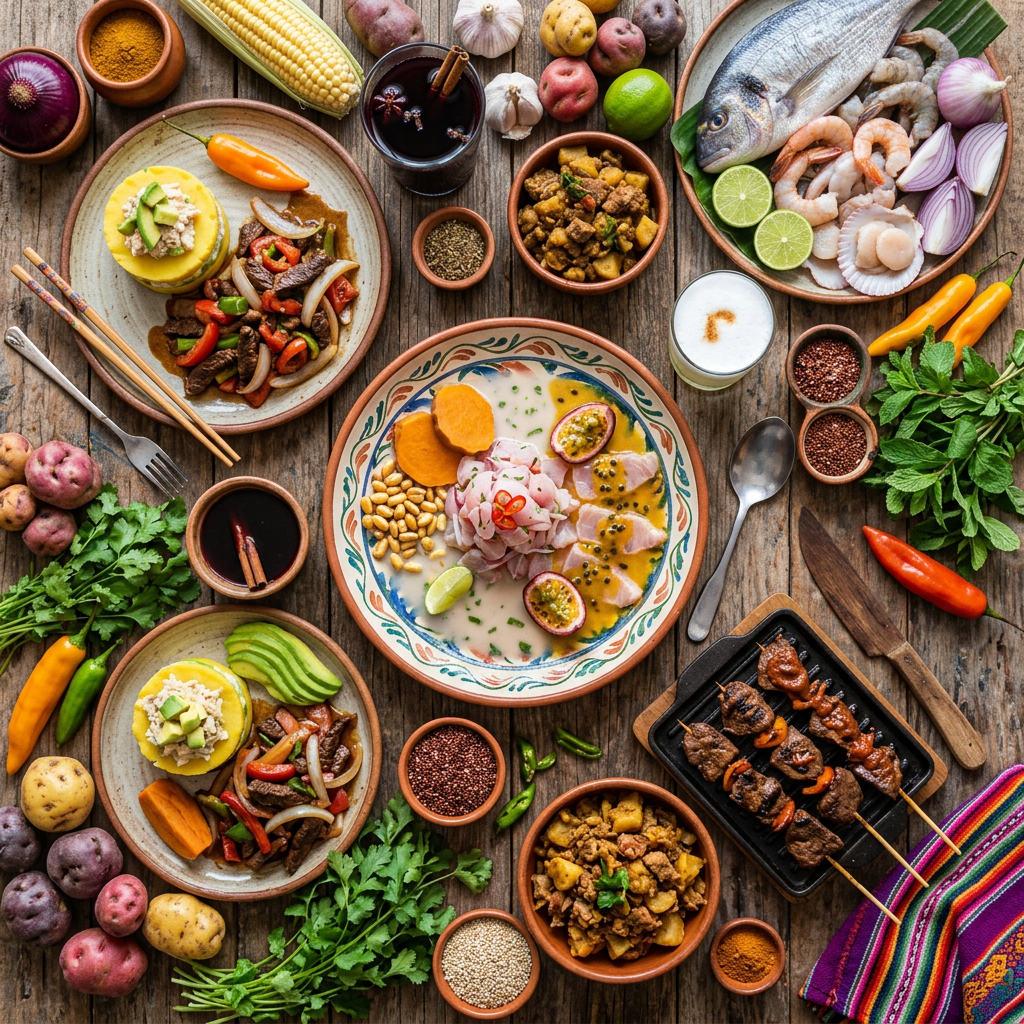
This post is a guide to the history of Peruvian cuisine — where it comes from, how five different cultures contributed to it, and why understanding that history changes how you eat when you travel to Peru.
Peru has been named the World’s Leading Culinary Destination by the World Travel Awards for over a decade. Lima appears regularly in lists of the world’s best cities for food. Peruvian restaurants have opened in every major European capital. And yet most travellers, when asked what they know about Peruvian food, say: ceviche. Maybe quinoa. Possibly something about potatoes.
The gap between what Peruvian food actually is and how it is understood outside Peru is significant. This post exists to close that gap — by explaining where the food comes from, what went into building it, and why it is genuinely unlike anything else on earth.
1. The foundation: the Andean kitchen
Before the Spanish arrived in 1532, the Andean civilisations had developed one of the most sophisticated food cultures in the world — at altitudes and in conditions that most agricultural societies would have found impossible.
Potato is the most significant legacy: Peru is the potato’s place of origin, with over 3,000 documented native varieties in colours ranging from white and yellow to purple, red, and black. The world eats Peruvian potatoes. Most of the world does not know this. Read more about the Peruvian potato history.
Corn was sacred in Andean culture. The Sacred Valley near Cusco was valued precisely because its microclimate allowed corn to grow at altitudes where it otherwise could not. It was used to make chicha — the fermented drink central to Inca ceremony and daily social life.
Quinoa, now a global health trend, was cultivated in the Andes for thousands of years as a staple protein source and was, like potato and corn, considered sacred.
Ají – the broad family of Peruvian chilli peppers — is the flavour backbone of the cuisine. Peru has dozens of native varieties, each with a different heat level, flavour, and use. Ají amarillo, ají panca, and rocoto are the three most essential.

2. The Spanish arrival — and what it changed
The Spanish conquest beginning in 1532 brought with it the ingredients of the Mediterranean kitchen: cattle, pigs, wheat, rice, garlic, onion, citrus fruits, and olive oil. The colonial period that followed meant, as El Comercio has described, three centuries of culinary mestizaje — a deep and sustained mixing of two food cultures that transformed both.
Lime juice — introduced by the Spanish — replaced the native acidic ingredients that coastal communities had previously used to cure fish, and in doing so created the version of ceviche that exists today. Onion became inseparable from Peruvian cooking. Rice, arriving via Spanish trade routes, is now a staple on virtually every Peruvian plate.
The exchange was not one-directional. The Spanish took potato, corn, tomato, and cacao back to Europe — ingredients that fundamentally changed European food culture. The potato alone, arriving in Europe in the second half of the 16th century, contributed to significant population growth across Northern Europe by providing a calorie-dense crop that could be grown in poor soil.

3. The African influence — and why it matters
Enslaved Africans arrived on the Peruvian coast from the 16th century onwards, brought to work on sugar and agricultural estates, in mines, and in domestic service. They brought their culinary traditions, ingredients, and techniques — and the result, forced into contact with Andean and Spanish ingredients, produced some of the most distinctive dishes in the entire Peruvian repertoire.
Ingredients including peanuts (maní), plantain, and yuca were introduced and absorbed into the local kitchen so completely that most Peruvians today do not think of them as arriving from elsewhere. Frying as a technique — applying direct heat to meat and vegetables — was also adopted and became embedded in coastal cooking.
The dishes that came from this tradition are now loved across the whole country.
Carapulca is one of the oldest surviving stews in Peruvian cooking — a slow-cooked dish of dried potato, peanuts, and meat seasoned with ají panca. The combination of Andean potato with peanut-based cooking technique is one of the clearest expressions of cultural encounter in the entire cuisine.
Anticuchos are skewered and grilled beef heart, marinated in ají panca, vinegar, cumin, and garlic. Their origin is well-documented in Afro-Peruvian culinary history: the Spanish considered offal undesirable, so those cuts were left to enslaved workers, who turned them into something remarkable. That story of resourcefulness becoming a national treasure is part of what makes Peruvian food culture so layered. Today anticuchos are sold from street grills at markets, football matches, and evening gatherings across the entire country — one of the most loved street foods in Peru.
Cau cau is a stew of tripe with potatoes, turmeric, and mint — also has Afro-Peruvian roots in both its preparation and its use of offal cuts. Warm, aromatic, and deeply comforting, it is a staple of coastal home cooking and one of those dishes that surprises visitors who try it without expecting to love it.

Anticuchos
4. The Japanese influence — Nikkei cuisine
In 1899 the first organised group of Japanese immigrants arrived in Peru — 790 people, according to the Asociación Peruano Japonesa, coming to work on coastal agricultural haciendas. They arrived on a ship called the Sakura Maru. Over the following decades the Japanese community in Peru grew significantly, settled primarily in Lima, and eventually numbered around 200,000 people across up to six generations — one of the largest Nikkei communities in the world.
The culinary result of this migration is recognised today as one of the most celebrated food traditions in the world: Nikkei cuisine — the fusion of Japanese culinary technique with Peruvian ingredients.
The foundations were laid by pioneering Nikkei cooks including Minoru Kunigami, Rosita Yimura, Augusto Kague, Darío Matsufuji, and Humberto Sato, alongside Japanese chef Toshiro Konishi. Japanese immigrants brought a precise, ingredient-focused cooking philosophy and their approach to raw fish preparation. Combined with Peru’s extraordinary Pacific seafood and the ají-based flavour palette of the existing cuisine, the result was something genuinely new: ceviche prepared with Japanese attention to texture and timing, tiradito (thin-sliced raw fish dressed with leche de tigre), and combinations that used soy sauce alongside ají amarillo in ways that should not work as well as they do.
The new generations of Nikkei chefs continued this work. Chef Mitsuharu Tsumura — Japanese-Peruvian, born in Lima —leads Maido, a Nikkei restaurant that has repeatedly appeared in the World’s 50 Best Restaurants list. In June 2025 Maido was named The World’s Best Restaurant in this ranking. Nikkei cuisine is now considered one of the most interesting culinary traditions in the world. Its origin is Lima.

5. The Chinese influence — El Chifa
Chinese immigration to Peru began in the mid-19th century. The first large groups of Chinese workers — primarily from Guangdong province — arrived as indentured labourers for coastal agricultural estates, guano collection, and railway construction. They settled, opened businesses, and began cooking.
The word chifa comes from the Cantonese chi fan — meaning “eat rice” — and entered the Peruvian Spanish vocabulary from the street calls of early Chinese vendors who invited locals to eat. According to the Instituto Peruano Chino, between 1870 and 1880 the first small Chinese-run eateries were already operating in Lima.
What happened next is one of the most complete cultural absorptions in any food culture. Chinese stir-fry technique met the Peruvian flavour palette. Soy sauce arrived alongside ají amarillo. The wok was applied to native Andean ingredients. The results — arroz chaufa, lomo saltado, tallarín saltado — became so embedded in everyday Peruvian eating that chifa stopped feeling like a foreign cuisine and became simply part of what Peruvians eat.
As a Peruvian, this is one of the most remarkable things about chifa: the word itself is so naturally part of the language that most Peruvians have never stopped to wonder where it came from. You do not go out for Chinese food. You go for chifa.

Lomo Saltado
What this means for the traveller
Understanding this history changes how you eat when you travel to Peru.
When you order lomo saltado, you are eating Chinese wok technique applied to Andean ingredients. When you eat ceviche, you are eating a dish whose lineage runs from pre-Hispanic coastal communities through the Spanish introduction of lime to modern Peruvian culinary identity. When you try anticuchos from a street stall, you are eating something that originated in survival and became a national staple. When you sit at a Nikkei restaurant in Lima, you are at the meeting point of two food cultures that had no reason to produce something this refined — and somehow did.
Five civilisations, five centuries, one plate.
That is why no other cuisine tastes like it.

Keep Exploring
If this history has made you curious about what the food actually tastes like on the ground — region by region, dish by dish — the rest of this blog is built around exactly that question. Read more about the Coast, the Andes, and the Amazon.
Which of the five culinary influences surprises you most? Leave a comment
Sources:
Asociación Peruano Japonesa — Los Nikkei en el Perú (apj.org.pe)
Instituto Peruano Chino — ¿Qué significa Chifa? (institutoperuanochino.com)
CETPRO Cajamarca — La influencia africana en la cocina peruana (cetprocajamarca.edu.pe)
El Comercio — Historia del anticucho (elcomercio.pe)
The World’s 50 Best Restaurants — Maido Named World’s Best Restaurant 2025 (theworlds50best.com)
5 responses to “The History of Peruvian Cuisine: Five Civilisations, One Plate”
-
Vraiment très intéressant et diversifié la cuisine péruvienne. C’est une vraie merveille à découvrir, la gastronomie!
-
Merci 😊
Tout à fait, la cuisine péruvienne fait vraiment partie de l’expérience du voyage.
-
-
Interesting read! Best of luck with your blog!
-
Thank you. And best of luck with your content as well! ✨
-
-
I love Peruvian food. I really enjoyed reading about the story behind it 🙂


Leave a Reply