Most people planning a trip to Peru build their itinerary around the same three stops: Lima, Cusco, Machu Picchu. The northern Peru coast rarely makes the list.
That may be an oversight.
The coastline that stretches from Trujillo north to Tumbes is one of the most layered regions in Peru — archaeologically, culturally, and gastronomically. It is where two of South America’s most sophisticated pre-Inca civilisations built their cities by the Pacific. It is where some of the continent’s best surf breaks. It is where the local food is shaped directly by the ocean, and where you can eat dishes that have existed in recognisable form for centuries. For a traveller who wants to understand Peru as a whole rather than as a single postcard image, the northern coast is an essential part of the picture.
What this guide covers
This post is organised around the things the northern coast does best: surf culture and the traditions behind it, marine life and the Pacific, the food you should not leave without eating, and the pre-Inca archaeological sites that give this coastline its historical depth. At the end you will find practical information for planning your visit.
1.The caballitos De Totora – a living tradition
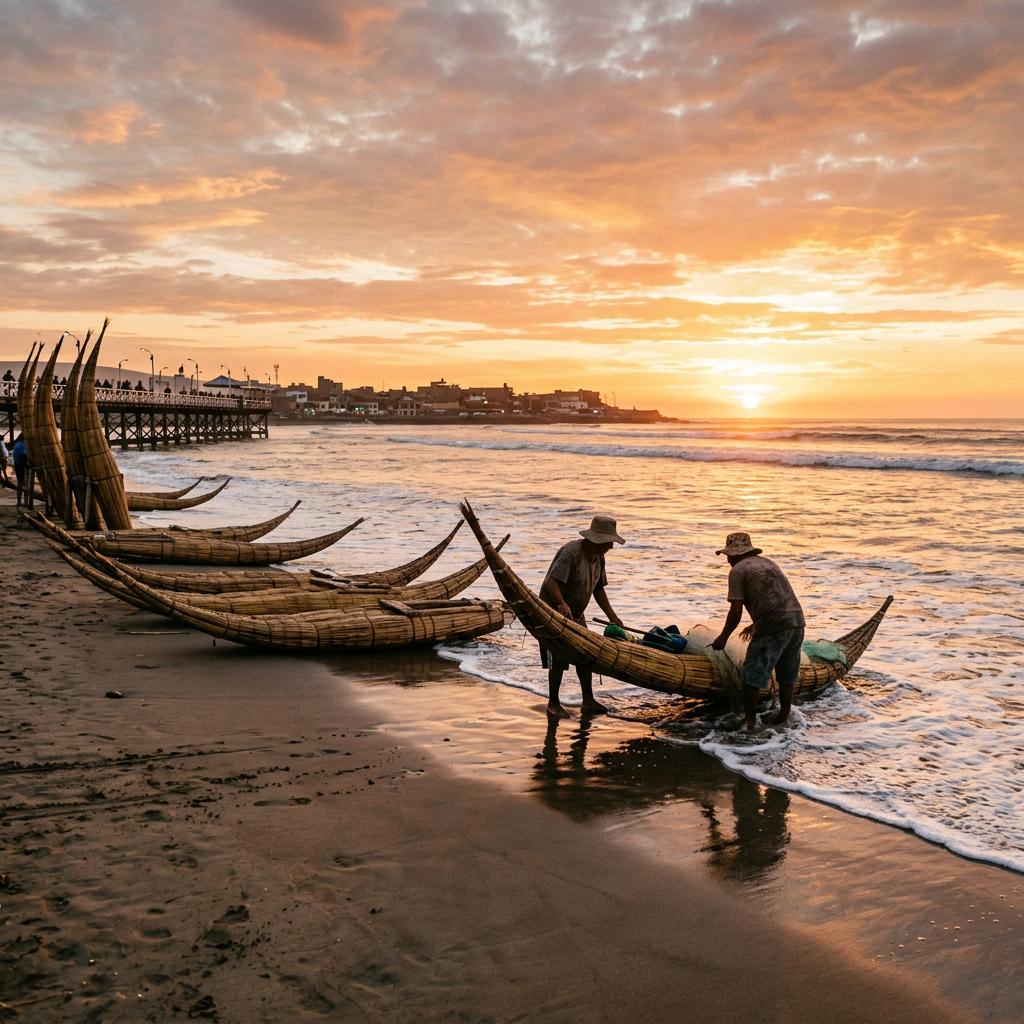
The first thing most travellers notice in Huanchaco is the fishermen.
Early in the morning, local fishermen carry long narrow boats made from totora reed down to the water, launch them into the surf, and paddle out to fish. The caballitos de totora — “little horses of totora reed” — are one of the most documented examples of continuous cultural tradition in South America. The Moche civilisation, which flourished on the northern coast between roughly the 1st and 8th centuries, depicted these boats repeatedly in their ceramics and iconography. The Chimú, who succeeded the Moche, continued the practice. The Spanish documented it in the colonial period. And the fishermen of Huanchaco are still using them today, in the same way, on the same beach.
They are also surfed. Huanchaco is widely cited as one of the places where the practice of riding waves on a craft has the longest continuous documented history in the world.
If you visit Huanchaco, go to the beach early. The fishermen launch at dawn, and watching them prepare and enter the water is one of those travel experiences that is difficult to describe accurately — it is simply more present.
Practical note: Huanchaco is a 20-minute taxi or bus ride from the centre of Trujillo. It functions as both a surf town and a weekend destination for Trujillanos. The beach itself is long, the waves are moderate and consistent, and the town is walkable and relaxed.

2. Surf on the northern coast
Beyond Huanchaco, the northern coast of Peru contains some of the most significant surf breaks in South America, and several that are genuinely world-class.
- Chicama (also known as Puerto Malabrigo) is the most famous break. It is widely regarded as having the longest rideable left-hand wave in the world, on a good day, a single wave can be ridden for over a kilometre, and in ideal conditions significantly more. The wave breaks slowly and consistently, which makes it as satisfying for intermediate surfers as it is for experienced ones.
- Máncora,further north in Piura, is the most developed surf destination on the coast. The water is warm year-round, the beach is long, and the town has surf schools, board rental, restaurants, and accommodation at multiple price points. It is also one of the few places in Peru where the beach works as a genuine beach holiday base.
- Cabo Blanco, between Máncora and Talara has a strong surf identity as well, with powerful and more demanding waves suited to experienced surfers.
When to go: The northern coast has surf year-round, but the most consistent swells generally run from November through March. Máncora’s warm water is an advantage in all seasons. For Chicama specifically, the wave works best in the Peruvian autumn and winter months (April through August) when offshore winds are more regular.

3. Marine life on the Pacific coast
The Pacific off northern Peru is shaped by the Humboldt Current, a cold-water current that runs up the South American coast from the south and creates an unusually rich marine ecosystem.
Whale watching is the most sought-after experience, and Los Órganos — a small fishing town in the Piura region, about 30 minutes south of Máncora — is the main base for it. Humpback whales pass through the waters off northern Peru between June and October, with July, August, and September typically offering the highest probability of sightings. Tours depart from Los Órganos and typically run two to three hours. The experience varies depending on conditions and season, but August and September are generally considered the peak months.
Sea turtle sightings at El Ñuro, just south of Los Órganos, are reliable year-round. Green sea turtles gather in the shallow water close to shore and are visible from the beach or while snorkelling. This is one of the most accessible and undervisited wildlife experiences on the Peruvian coast.
Practical note: Los Órganos itself is a quiet, local town without much tourism infrastructure — which is part of its appeal. If you are combining whale watching with a beach stay, Vichayito (a few kilometres south) or Máncora are the most practical bases.

4.The food of the northern coast
Food on the northern coast is direct, generous, and shaped entirely by the Pacific. It is also, in important ways, different from the Peruvian food most travellers are familiar with — which tends to be Lima-centric and refined. Northern coastal food is rawer and closer to its ingredients-
Ceviche is the essential starting point, but the version you eat on the northern coast is not the same as Lima ceviche. It tends to be simpler in construction and more focused on the quality of the fish itself — typically sea bass (corvina) or sole (lenguado), cured in lime juice with red onion, chilli, and salt. The leche de tigre (the curing liquid, which is drunk or eaten separately) is unmatched thanks to the freshness of the fish in a coastal town.
Chinguirito is a northern speciality that exists almost nowhere else in Peru. It is a ceviche made with dried and shredded guitarra fish (guitarfish) — the drying technique is a preservation method with pre-Hispanic roots that persists in northern coastal cooking. The flavour is more intense than fresh ceviche, concentrated and slightly funky in the way of any good dried fish preparation. It is not universally loved on first encounter, but it is worth trying once for what it tells you about the region’s food culture.
Sudado de pescado — a warm fish stew cooked with tomato, onion, ají amarillo, and chicha de jora — is what coastal families cook at home. It rarely appears on restaurant menus aimed at tourists. If you see it on a menu or can ask for it specifically, order it. The cooking liquid is extraordinary.
Where to eat : In Trujillo itself, the Mercado Central and the area around it has excellent and inexpensive local food.
Want to understand why the food here tastes like nowhere else? → Read more at The history of Peruvian cuisine

5. The Pre-incas Civilizations
Peru is most widely associated with the Inca. But the Inca Empire lasted less than a century before the Spanish conquest. The civilisations that preceded it on the northern coast had been building complex societies here for more than a thousand years.
The Moche (roughly 1st to 8th century) were extraordinary ceramic artists and hydraulic engineers who built monumental ceremonial centres in the coastal valleys. Huaca de la Luna, just outside Trujillo, is their best-preserved site. The polychrome murals inside — depicting deities, ritual scenes, and geometric designs — retain much of their original colour after more than 1,500 years. The site has an on-site museum and guided tours.
The Chimú succeeded the Moche and built Chan Chan, the largest pre-Columbian city in South America, just west of Trujillo. At its height it covered approximately 20 square kilometres . Chan Chan is a UNESCO World Heritage Site and is also on the UNESCO List of World Heritage in Danger due to erosion — which makes visiting it now more significant than it might otherwise seem.
The Royal Tombs of Sipán Museum in Lambayeque (45 minutes north of Trujillo) houses the burial goods of a Moche lord discovered in 1987 in one of the most significant archaeological finds in the Americas. The gold and silver work alone justifies the journey. It is considered one of the finest archaeological museums in South America.
Practical note: A guided tour makes a significant difference at all three sites. Most operators in Trujillo offer combined day trips to Chan Chan and the Huacas. Budget a full day for the Trujillo sites and a separate half-day for Sipán.

6. How to plan your visit
Getting there: Trujillo has its own airport with regular flights from Lima (approximately one hour). Overnight buses from Lima are comfortable and take around nine hours. Máncora is reached by bus from Trujillo in approximately six hours.
How much time: Three to four days around Trujillo covers the archaeology, Huanchaco, and eating well. Add two to three days in Máncora or Los Órganos if beach time and whale watching are priorities.
Where the north fits in a Peru trip: The coast works well as an opening to a longer Peru itinerary — fly into Trujillo, spend four days, then fly to Cusco. It also works as a closing segment after the Andes, offering warm weather and ocean as a contrast to altitude.
Keep Exploring
The northern coast is where Peru’s story is oldest and most directly written in the landscape — in the fishermen, the ruins, the waves, and the food. If it has made you curious about what happens when you move inland and upward, the Andes and the Amazon are next.
Which part of the northern coast interests you most — the archaeology, the surf, or the food?
Leave a comment below.
Posts


3 responses to “Discover Hidden Northern Peru Coast: Surf, Culture & Food”
-
Je suis plutôt attiré par ses plages et sa gastronomie.
-
Je comprends 😊
Si vous aimez les plages et la gastronomie, le nord du Pérou est l’une des meilleures régions à explorer.
-
-
Seems amazing !
Always feels good to discover new horizons, helps to escape from our realities.
I would be honored to head there one day


Leave a Reply