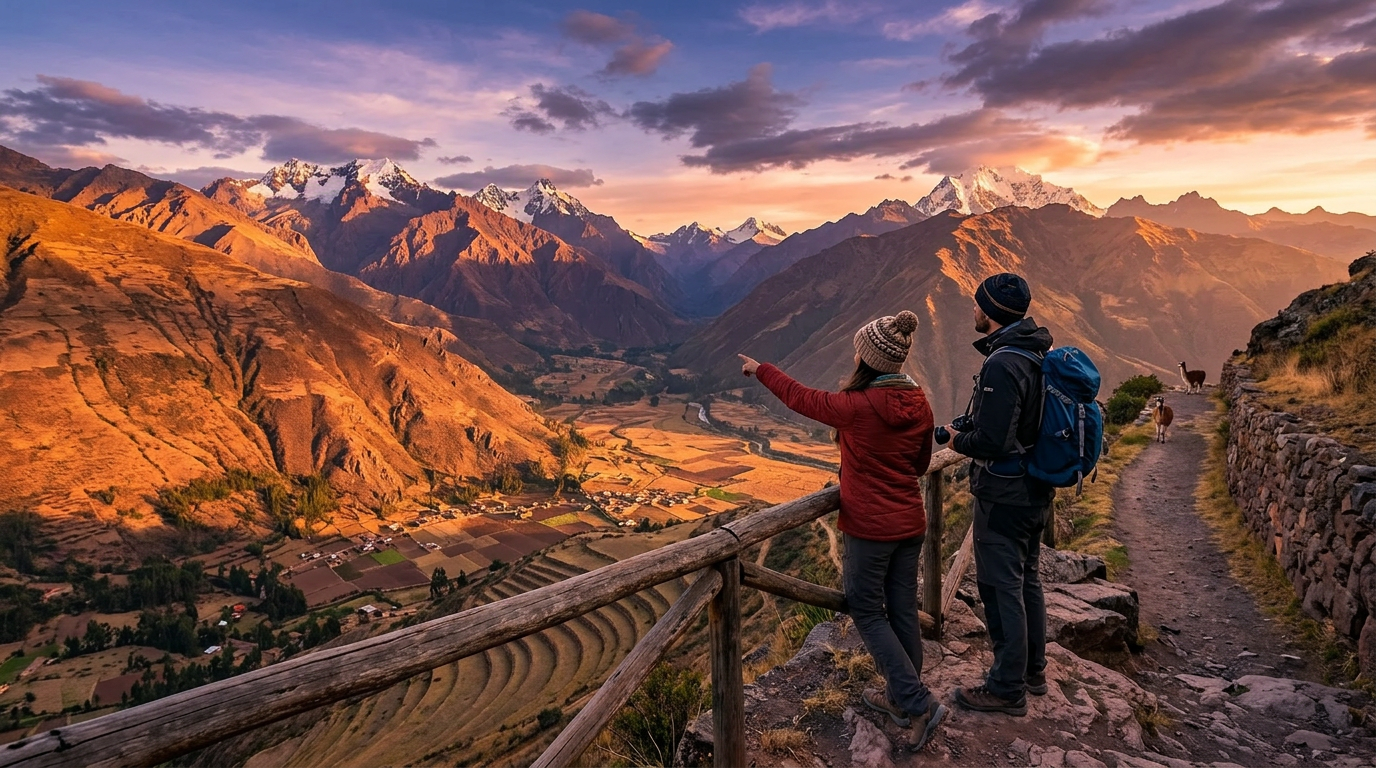
Most Peru itineraries are built around what to see. This one is built around what to eat — and what the food tells you about where you are. This is the itinerary I give friends visiting for the first time: honest, specific, and focused on the experiences that stay with you.
I have crafted two exciting options for you: a vibrant 2-week itinerary perfect for those with limited time and an enriching 3-week extension that allows for a more immersive experience. Both journeys celebrate the incredible food, lively culture, and breathtaking landscapes, ensuring you gain a genuine and unforgettable insight into the heart of Peru.
Personal footage from Peru. Filmed by Sofia.
The 2-week itinerary
Days 1–2: Lima — gastronomy capital of South America
Day 1 — Miraflores, the coast, and your first ceviche
Lima can be explored in just two days, which should focus on food. Upon arrival, drop your bags in Miraflores, the safest area for first-time visitors, and head to the seafront. The Malecón de Miraflores features a stunning urban coast with the Pacific Ocean to the west, paragliders in the sky, and amazing sunset views.
That evening, dine in Barranco, the neighborhood south of Miraflores, known for its old houses turned into restaurants and bars. Try pollo a la brasa (rotisserie chicken with chips and creamy sauces—Lima’s beloved dish) and enjoy it with an Inca Kola, a bright yellow soft drink that tastes like bubblegum and is actually more popular than Coca-Cola in Peru.

Pollo a la brasa
Day 2 — Ceviche morning, Larcomar, optional Chifa
Ceviche in Lima is primarily a morning dish. Fresh fish is delivered overnight, prepared early, and served from around 11am until it sells out, usually by 2pm. Eating ceviche for dinner is not recommended in Peru. Visit a cevichería market like Mercado N°1 in Surquillo at 11am. Order a ceviche clásico with corvina or lenguado, a leche de tigre shot, and a cold chicha morada.
Spend the afternoon at Larcomar in Miraflores for stunning coastal views, not just shopping. Then, visit the Larco Museum in Pueblo Libre, which has the best pre-Columbian collection in the country. In the evening, try chifa, a unique Peruvian-Chinese fusion cuisine that has been part of Lima’s food culture since the 19th century. It’s different from Chinese food anywhere else, so ask locals for their favorite chifa spot.
If you’re looking for a special dinner in Lima: Maido is a top restaurant known for its Nikkei cuisine (Peruvian-Japanese fusion) and requires months of advance reservations from Europe. If you can get a spot, go for it. If not, you can enjoy excellent meals at La Mar in Miraflores or Isolina in Barranco without the wait.
⤷ Alternative: If you have an extra day before heading north: take a day trip to Paracas (2.5 hours south of Lima) for the Ballestas Islands — sea lions, penguins, and Humboldt current birdlife — and the surreal landscape of the Paracas desert meeting the Pacific. From Paracas, it is a short distance to Huacachina: a genuine oasis surrounded by sand dunes, with sandboarding and dune buggy rides at sunset.

Days 3–4: Northern Coast
Day 3 — Lima to Trujillo: Chan Chan and the coastal kitchen
Fly or take an overnight bus to Trujillo, where an exciting adventure awaits. Discover Chan Chan, the incredible adobe city of the Chimú, which proudly stands as the largest pre-Columbian city in South America, just thirty minutes from Trujillo. Spend a delightful morning exploring its wonders. In the afternoon, head to the charming beach town of Huanchaco, where you can witness the caballitos de totora — the ancient reed boats featured in Moche ceramics from 2,000 years ago — gracefully setting sail at dawn.
The food in Huanchaco is direct and honest: fresh fish arrived that morning, prepared simply. Order whatever the day’s catch is, fried or in a ceviche. The northern coast ceviche uses different chillies and a heavier hand with garlic than the Lima version — it is worth comparing.
Day 4 — Huanchaco: sunrise with the fishermen, then south to Cusco
If you wake early enough, the caballito fishermen return at dawn. Watch from the beach. Then travel south toward Lima for your connection to Cusco.
💡 The northern coast is systematically undervisited by European travellers. If you have flexibility, add a night in Chiclayo: the Señor de Sipán museum contains some of the finest pre-Inca gold in the world, and the ceviche of the north is different enough from Lima to justify the detour.
⤷ Alternative: Alternative route for surfers and adventure travellers: From Trujillo, continue north to Máncora — Peru’s main surf town, 14 hours by bus or 1 hour by plane, with warm water, consistent breaks, and a laid-back beach culture entirely different from the rest of the country. This replaces the Cusco-first structure and is best combined with a flight into Lima, surf days in Máncora, then fly to Cusco from Piura.

Huanchacho
Days 5–9: Cusco — the navel of the Inca world
Give Cusco five days. The city rewards time, and the altitude (3,400 metres) demands it. The first day should be calm.
Day 5 — Arrival and acclimatisation
Arrive and drink coca tea; it helps. Eat light: soup or something warm, but avoid heavy meals. Don’t do anything strenuous. Walk slowly to Plaza de Armas in the late afternoon — the most beautiful square in South America, surrounded by colonial buildings on Inca stone foundations. You can see the history in the stonework: Inca precision below, Spanish baroque above. Eat at Mercado San Pedro for dinner — a market two blocks from the Plaza with food stalls serving traditional dishes.
Day 6 — Cusco in depth: Sacsayhuamán, museums, folklore
Buy the tourist pass (boleto turístico) on your first full day — it covers Sacsayhuamán, the museums, and several other sites and pays for itself immediately. Start at Sacsayhuamán, the enormous Inca fortress above the city, where the scale of the stonework remains genuinely incomprehensible even after you have stared at it for an hour. Walk down through the San Blas neighbourhood — the most beautiful part of Cusco, full of artists’ workshops and quiet streets — to the Qorikancha, the Inca temple of the sun beneath the Santo Domingo church. In the evening, go to a folkloric show: the Centro Qosqo de Arte Nativo puts on nightly performances of Andean music and dance that are worth attending not as a tourist spectacle but as documentation of a living tradition.
💡 The Mirador de San Cristóbal, above the San Blas neighbourhood, gives the best view over Cusco. Go at sunset. Take it slowly — the altitude is still in your legs at this point.

The view from Mirador de San Cristóbal over the Plaza de Armas.
Day 7 — Sacred Valley full day: Pisac, Ollantaytambo, Maras-Moray
A full day in the Sacred Valley is one of the best days you can spend in Peru. Start early at the Pisac market — attend on Tuesday, Thursday, or Sunday for the full community market, when vendors from the surrounding highlands bring native potato varieties, dried chillies, quinoa, and hand-woven textiles. Buy and eat. The food stalls inside the market serve chicharrón de cerdo with mote and chicha: an Andean breakfast that will carry you until afternoon.
Continue to Maras (the colonial salt pans, terraced into a hillside and still harvested by hand) and Moray (the circular Inca agricultural terraces, designed to create different microclimates at different depths — possibly the most extraordinary agricultural experiment in the ancient world). Then Chinchero, the highland weaving community where you can watch traditional backstrap loom weaving and buy directly from the weavers.
End the day in Ollantaytambo for dinner. The temple ruins above the town are among the finest examples of Inca stonework still standing. For dinner, go to Apu Veronica — a small, well-run restaurant in Ollantaytambo that takes Andean ingredients seriously and serves them with genuine care. Order whatever the kitchen is making with local produce that day.

Moray
Day 8 — Machu Picchu
The night before, stay in Ollantaytambo — you are already on the train line and the morning is far less rushed. Book Machu Picchu entry at machupicchu.gob.pe (official only, not third-party agents) and train tickets at perurail.com or incarail.com at the same time — both sell out months ahead in peak season. The train journey through the cloud forest is one of the most beautiful in South America.
Aim for a midday entry slot rather than dawn — Machu Picchu sits in a cloud forest and the early morning is often completely white with mist. By midday the clouds typically lift and you get the site in full light. What most visitors miss are the agricultural terraces below the citadel — not decoration, but the system that fed the entire complex. Take the 5pm train back from Aguas Calientes to Ollantaytambo and continue to Cusco that evening.
💡 The Camino Inca (Inca Trail) is a 4-day trek through cloud forest and high mountain passes that ends at Machu Picchu through the Sun Gate at dawn. Permits are strictly limited and sell out a year in advance. If this interests you, book a full year before your trip. It is a completely different experience from arriving by train — and for many people who have done both, it is the better one.

Machu Picchu, taken on one of my trips back home
Day 9 — Vinicunca (Rainbow Mountain) or rest day
Vinicunca — the Rainbow Mountain, at 5,200 metres — became internationally famous around 2015 and is now one of the most visited sites in the Cusco region. The colours are real (caused by mineral deposits in the soil) and the high-altitude landscape is extraordinary. The hike is steep and demanding at altitude. If you are acclimatised and in good health, it is worth it. If you have any doubt about your altitude fitness, skip it and spend the day in Cusco eating at Mercado San Pedro and visiting the remaining museums on your tourist pass.
⤷ Alternative: Other trek options from Cusco: Lares Trek (4 days, passes through remote highland communities with thermal baths), Salkantay Trek (5 days, crosses a 4,600m pass under the Salkantay glacier before descending to Aguas Calientes). Both are less crowded than the Inca Trail and available with more flexible booking.
Days 10–12: Amazon — Puerto Maldonado
A one-hour flight from Cusco puts you in Puerto Maldonado, the gateway to the Madre de Dios Amazon. The biodiversity here is extraordinary — the Manu Biosphere Reserve, accessible from Cusco, is one of the most species-rich places on Earth. For a two-week itinerary, Puerto Maldonado with three nights at a jungle lodge is the most practical option.
The jungle kitchen is unlike anything in the highlands or on the coast: paiche (the enormous Amazonian fish, firm-fleshed and mild), patarashca (fish wrapped in bijao leaves and cooked over fire), chonta (heart of palm in salads and stews), juane (a rice and meat parcel wrapped in banana leaves, traditionally eaten at the festival of San Juan). Eat everything. Ask the lodge kitchen what is local and seasonal.

Days 13–14: Return to Lima
All international flights leave from Lima, so your last days bring you back. Use them. If you did not make it to the Surquillo market on the way in, go now. If you did — go again. Lima rewards return visits in a way that few cities do: the food culture is large enough and diverse enough that you will eat something different every time.
Peru has a way of making you feel, on the last day, that you have only just started to understand it. That feeling is correct. Come back.
──────────────────────────────────────────────────────────
The 3-week extension — for those who want to go deeper
Three weeks allows you to add Arequipa (Peru’s second city and its most distinctive food culture), the Colca Canyon, and Lake Titicaca — three experiences that give you a Peru the two-week route cannot reach. Here is how to build the extension.
Add after Cusco: Arequipa (Days 10–12)
Fly or take the overnight bus from Cusco to Arequipa. Arequipa is built in white volcanic sillar stone and has the most distinct regional cuisine in Peru. The dishes to eat: rocoto relleno (stuffed hot pepper — significantly spicier than it looks; do not underestimate it), ocopa arequipeña (boiled potato with a sauce of huacatay herb, cheese and dried chilli — entirely different from huancaína), chupe de camarones (freshwater prawn chowder with eggs and cheese, eaten as Sunday lunch by every family in the city), and pastel de papa (layered potato with cheese and milk, served alongside the rocoto as a counterpoint to the heat).
Spend one morning at the Convent of Santa Catalina — a walled city within a city, covering an entire block of Arequipa, where cloistered nuns lived in complete isolation for three centuries. It is one of the most extraordinary colonial buildings in South America and is worth two hours of slow walking.

Rocoto relleno
Add: Colca Canyon (Day 13)
A four-hour drive from Arequipa brings you to the Colca Canyon — one of the deepest canyons in the world, and one of the best places on Earth to see Andean condors in flight. The Cruz del Cóndor viewpoint at 7am, when the thermal currents begin and the condors rise from the canyon floor, is a genuinely extraordinary moment. Stay overnight in Chivay, the main town in the valley, for the thermal baths and highland food.

Cañon de Colca
Add: Lake Titicaca / Puno (Days 14–15)
From Colca, continue to Puno on the shores of Lake Titicaca — the highest navigable lake on Earth at 3,800 metres, shared between Peru and Bolivia. The floating islands of the Uros are the most visited attraction: communities who have lived on islands built entirely from totora reeds for centuries. The experience is partially shaped by tourism now, but the underlying knowledge — how to build, maintain, and live on a floating island — is real and extraordinary. If you have the time, the island of Taquile in the middle of the lake, where the community maintains strict dress codes and traditional textile practices, is the more authentic visit.
From Puno, take the bus to Cusco (5 hours) or fly back to Lima for your international connection.
Alternative extension: Nazca Lines and Huacachina
If the Amazon does not appeal but the desert does, replace Days 12–13 with a trip south from Lima. Paracas and the Ballestas Islands for one night, then Ica for Huacachina — the sand-dune oasis where you can sandboard and take dune buggy rides at sunset — and an overflight of the Nazca Lines (30-minute small plane flight over the geoglyphs, booked locally in Nazca or in advance online). This route is best done by bus from Lima (comfortable overnight services connect the entire south coast) and takes you through one of the most dramatic desert landscapes in the world before returning to Lima for your flight.

Nazca lines
Practical notes for both itineraries
Machu Picchu tickets: Book at machupicchu.gob.pe — official only. Book the moment you confirm your travel dates. Peak season (June–August) sells out months in advance.
Train tickets: PeruRail (perurail.com) or Inca Rail (incarail.com) for Ollantaytambo–Aguas Calientes. Book these at the same time as Machu Picchu entry.
Altitude: Cusco at 3,400m affects almost everyone for the first 48 hours. The local advice is the right advice: arrive slowly, eat lightly, drink coca tea, rest. Acetazolamide (Diamox) is available in Cusco pharmacies.
What to drink: Inca Kola with pollo a la brasa and chifa. Chicha morada everywhere else. Pisco sour for the first night in Lima. Chicha de jora in the highlands if offered.
Eating hours: Ceviche: 11am–2pm only. Lunch is the main meal in Peru (1–3pm). Dinner is lighter and later (8pm+). Market food stalls are best at breakfast and lunch.
Read next
For the cultural context behind everything in this itinerary: Pachamama Meaning and 15 Quechua Words That Change How You Experience Peru. For the food history: The History of Peruvian Cuisine: Five Civilisations, One Plate.
Thinking about booking your trip?
If you have questions about a specific part of the route — whether it’s what to eat in a particular region, how to effectively manage the altitude, or what essential experiences most visitors overlook that you definitely shouldn’t — don’t hesitate to leave a comment below or contact me directly at discoverperublog@gmail.com
3 responses to “The Real Peru Itinerary: 2 or 3 Weeks, Food First — Written by a Peruvian from Cusco”
-
Le Pérou c’est un pays très riche en histoire et diversité culturelle. Ça donne envie de faire un voyage et découvrir des nouvelles choses.
-
Thank you for sharing these tips with us 🙂
-
Thank you for reading Céline, hope they help with planning a future Peru trip! 🌿
-


Leave a Reply